· ReadyStack
Worked example
Real numbers from this tool, line by line.
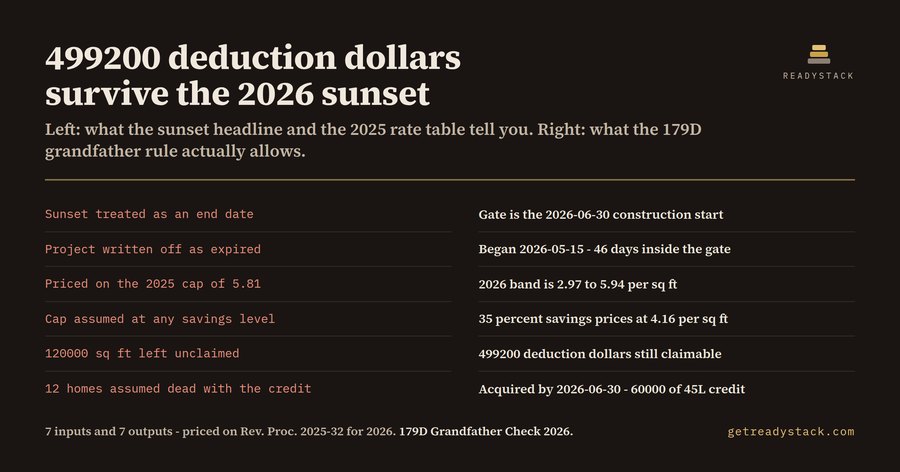
A US design-build contractor whose school retrofit broke ground on 2026-05-15 still has 499200 deduction dollars on the table, 46 days inside the 179D gate that the 2026 sunset was supposed to close. Nearly every free answer says the opposite.
The One Big Beautiful Bill Act terminated the Section 179D energy efficient commercial buildings deduction for property whose construction begins after 2026-06-30. It terminated the Section 45L new energy efficient home credit for homes acquired after 2026-06-30. Both dates are behind us, and the word sunset did the rest: it reads like an end date, so the standard answer in late 2026 is that 179D is finished.
That is wrong, and expensive. The gate is the construction start date, not the placed-in-service date. A project that began construction on or before 2026-06-30, under the physical work test or the 5 percent safe harbor with continuous efforts, stays fully eligible. It is claimed in its placed-in-service year, and that year can be 2027 or 2028. So the question is not whether 179D exists; it is a date, a floor area and a modeled savings number.
Take the school retrofit. Construction start 2026-05-15, which the tool scores at 46 days inside the gate. Conditioned floor area 120000 sq ft. Modeled energy cost savings 35 percent against the ASHRAE baseline. Prevailing wage and apprenticeship met. Rev. Proc. 2025-32 sets the 2026 Section 179D band at 2.97 to 5.94 per sq ft when those wage requirements are met, sliding with modeled savings from 25 percent to 50 percent. At 35 percent the rate is 4.16 per sq ft, and 120000 sq ft at 4.16 is 499200 dollars. Claimed on the 2027 return.
Free tools miss twice there: the rate is 4.16, not the 5.94 cap, which only arrives at 50 percent savings; and the 2026 band tops out at 5.94 where the 2025 band stopped at 5.81.
Now the other direction. A 240000 sq ft warehouse, 45 percent modeled savings, prevailing wage met, construction start 2026-07-02. At 45 percent the rate is 5.35 per sq ft, so the deduction would have been 1284000 dollars. It is 0. The project missed the gate by two days. There is no partial credit on that date.
Section 45L runs on its own gate. Homes acquired on or before 2026-06-30 still earn 2500 per ENERGY STAR certified home and 5000 per DOE Zero Energy Ready home. A production builder with 40 ENERGY STAR homes acquired 2026-03-10, on a 48000 sq ft project at 28 percent savings without prevailing wage, gets a 179D rate of 0.66 per sq ft for 31680 dollars, plus 100000 dollars of 45L credit. Total 131680 dollars, claimed on the 2026 return. The 45L half is more than three times the 179D half, and anyone who wrote the year off would have missed it.
The extension takes 7 inputs and returns 7 outputs: the gate result, the days inside the 2026-06-30 gate, the 2026 rate per sq ft, the 179D dollars still claimable, the 45L credit, the total, and which return it goes on. All of that is free, for every project, with no key and no cap.
The paid layer sits on a different axis: for 60 dollars once it writes a dated CSV row for every project you have checked, the file a CPA actually wants, and sets alarms before a placed-in-service or amended-return window closes.
For proportion: a third-party 179D engineering study with a site visit and full energy model is commonly quoted at 5000 to 15000 dollars per building. That is the right spend on a project that clears the gate, and a painful one on a project that started 2026-07-02 and never qualified. Sorting the two takes a minute, and no project data leaves the browser.
Questions people ask
What does the 179D Grandfather Check actually do?
It answers one question the 2026 sunset made confusing: is this project still worth a 179D deduction? You give it 7 inputs - construction start, conditioned floor area, modeled savings, prevailing wage status, placed-in-service year, homes acquired, and their 45L tier - and it returns 7 outputs, including the gate result, the 2026 rate per sq ft, and the deduction dollars still claimable.
Who is this for?
US architects, engineers and design-build contractors who take 179D allocations from government and tax-exempt building owners, and home builders still holding 45L homes. If you are deciding whether a 2026 project is worth the cost of an energy model and an allocation letter, this is the check that comes first.
Why will a free chatbot not answer this?
Because the sunset reads like an end date and the models were trained on the old rules. Ask one about 179D in late 2026 and it will tell you the deduction is gone. It is not gone for projects that began construction on or before 2026-06-30, and the free calculators that survive still price on the 2025 table of 5.81 per sq ft rather than the 2026 cap of 5.94.
What is free and what needs the paid key?
The whole calculation is free, for every project, with no key and no cap: the gate test, the 2026 rate, the 179D dollars, the 45L credit and the return it goes on. The 60 dollar key adds a different axis - a dated CSV of every project you have checked, so you can hand it to a CPA, and alarms before a placed-in-service or amended-return window closes.
What would this cost me otherwise?
A third-party 179D engineering study with the site visit and energy model is commonly quoted at 5000 to 15000 dollars per building. That is the right spend once you know a project clears the gate. It is a painful spend on a project that started 2026-07-02 and never qualified at all, which is exactly what this check tells you first.
Ask about this tool
One question, answered by the person who built it. Your email only if you want the answer sent.